
McChrystal's Star Gazer: A Review of Britain's Finest Anise Snuff
The Case for Nasal Snuff in 2026
There is something quietly countercultural about nasal snuff. In an age of vape clouds, nicotine pouches, and disposable everything, pulling out a small tin and taking a considered pinch feels almost like a philosophical statement. No combustion. No device. No subscription. Just finely milled tobacco, a pocket tin, and a practice stretching back several centuries.
I have used nasal snuff regularly for some time now, alongside snus. The two complement each other well. Snus handles situations where discretion and duration matter. Snuff handles the moments when you want something immediate, aromatic, and grounded in a longer tradition than most people alive can remember. Living on a narrowboat on the English canals, there is a fitting symmetry in reaching for a product that would not have seemed out of place on these same waterways two hundred years ago.
Of the snuffs I rotate, McChrystal's Star Gazer is the one I return to most consistently. This review explains why, and examines the broader story of the blend, including the regulatory episode that forced a name change and nearly obscured one of the most distinctive flavour profiles in the British snuff catalogue.
McChrystal's: Background Worth Knowing
McChrystal's (Leicester) Ltd has been producing snuff since 1926, making it one of the few remaining independent British snuff manufacturers still operating on genuinely traditional lines. The company was founded by Denis McChrystal, an Irish immigrant working as a wholesale tobacconist in Leicester, who noticed unusually strong snuff sales in his area and decided to develop his own blends. He enlisted help from a chemist at Leicester University. His grandmother, an avid snuff user herself, approved the recipes. Production began in a garden shed.
The company formalised in 1954, mechanised through the late 1950s and 1960s, and has remained family-owned across four generations. The fourth generation, Charles McChrystal, joined in 2015. The recipes themselves have remained largely unchanged across nearly a century of production, handed down within the family in the traditional manner of a craft operation that understands its value lies in consistency.
That continuity matters. It means Star Gazer is not a reformulation, a marketing refresh, or a contemporary interpretation of what anise snuff should taste like. It is the real thing, made the way it has always been made, using a Wilson's of Sharrow base blend of burley, flue-cured, and oriental stem tobacco. When you take a pinch of Star Gazer, you are taking a pinch of something that has been made in Leicester, by the same family, to the same recipe, for the better part of a century.
Star Gazer: The Name Change and What It Tells You
This blend was not always called Star Gazer. For many years it was sold as Anisette, a name that described the flavour profile with reasonable accuracy. Anisette is an anise-flavoured liqueur, and the snuff did, and still does, carry that same sweet, herbal, licorice-forward character.
The name change was a consequence of the EU Tobacco Products Directive (Directive 2014/40/EU), transposed into UK law via the Tobacco and Related Products Regulations 2016. The TPD introduced restrictions on characterising flavours and, critically, on product names and labelling that could imply an association with alcoholic drinks or create a misleading impression of reduced harm. "Anisette," being the name of an alcoholic drink, fell foul of those provisions. McChrystal's renamed the blend Star Gazer, a neutral and evocative name that references nothing in particular, complies with the regulations, and preserves the product itself entirely intact.

This is worth noting for two reasons. First, it illustrates how tobacco regulation under the TPD framework reached further than simple health warnings. Naming conventions, flavour descriptors, and packaging aesthetics all became subject to regulatory control, with small manufacturers like McChrystal's required to navigate compliance without the legal departments that larger tobacco companies deploy as a matter of routine. Second, it means that anyone searching for "Anisette snuff" and finding nothing may have simply failed to locate Star Gazer under its current name. The product did not disappear. It was renamed, and the blend was untouched.
Post-Brexit, the UK retained the TPD framework through the retained EU law mechanism, so the name Star Gazer is here to stay regardless of any future regulatory divergence. The tin you buy today carries the same contents as the Anisette tin it replaced.
The Product: What You Are Actually Getting
Presentation
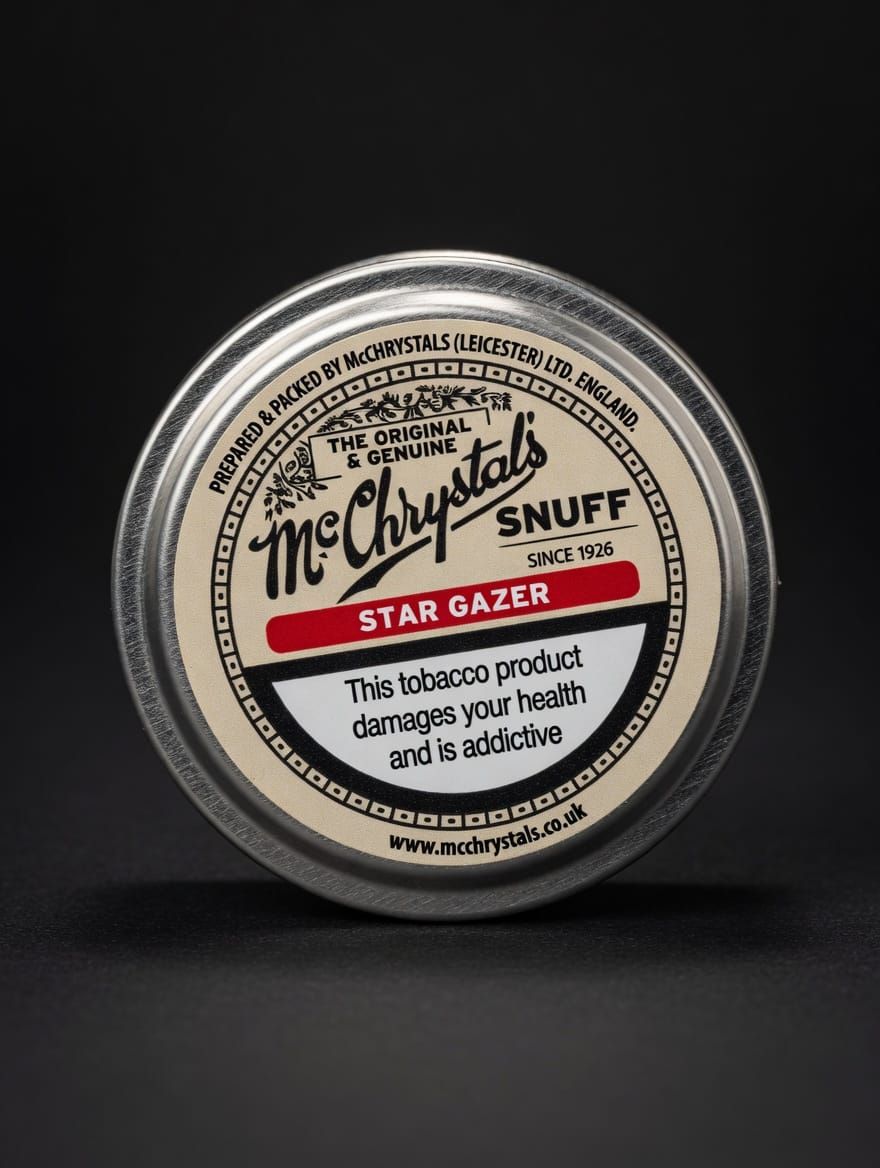
Star Gazer comes in a small, flat, screw-top metal tin, consistent with McChrystal's standard format. The label is cream and black with a distinctive red band bearing the product name. It is compact enough to sit flush in a jacket pocket or the small compartment of an EDC pouch without creating a bulge. The tin construction is solid, the lid seals reliably without being difficult to open one-handed, and the format has the reassuring permanence of something that has not been redesigned because there was no reason to redesign it.
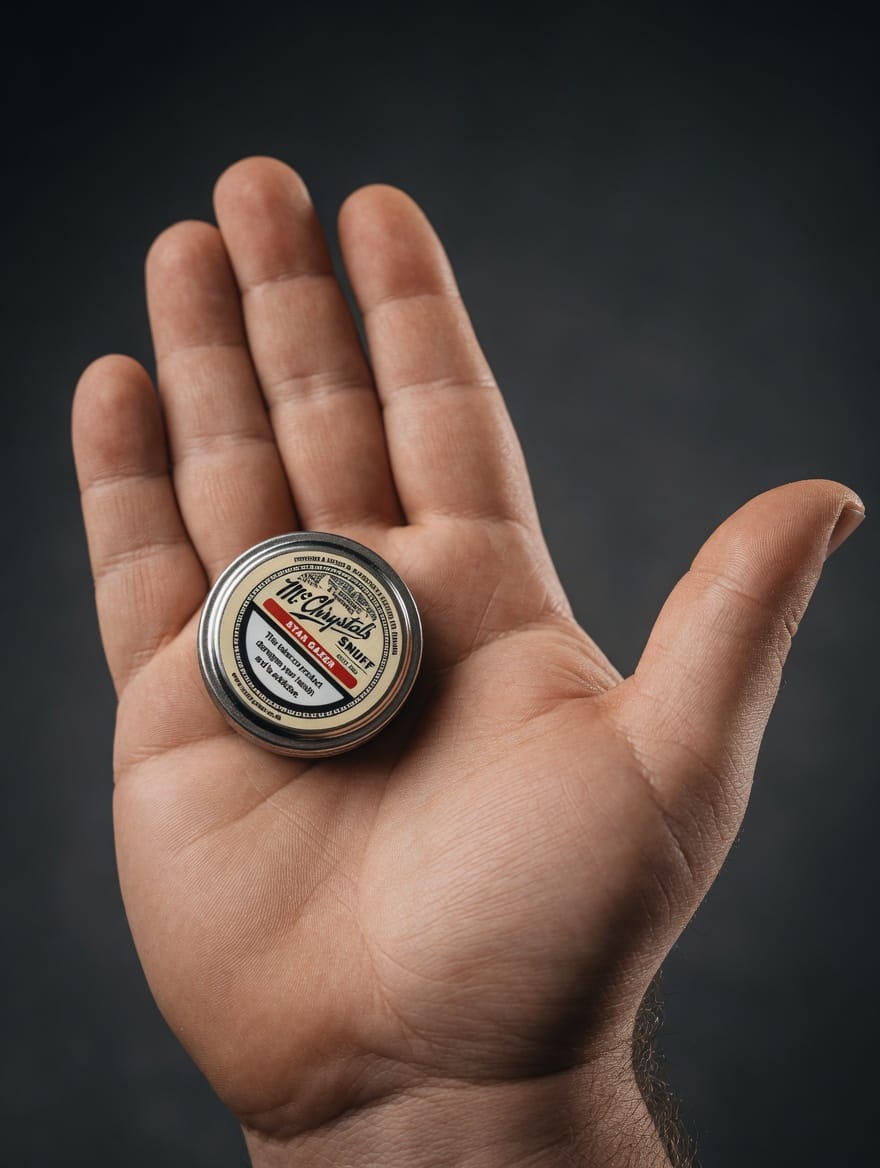
The standard size is 8.75g. This is a sensible quantity. It does not dry out before you finish it if you use it with any regularity, and it is priced at a level that does not make daily use a significant outlay.
Grind and Moisture
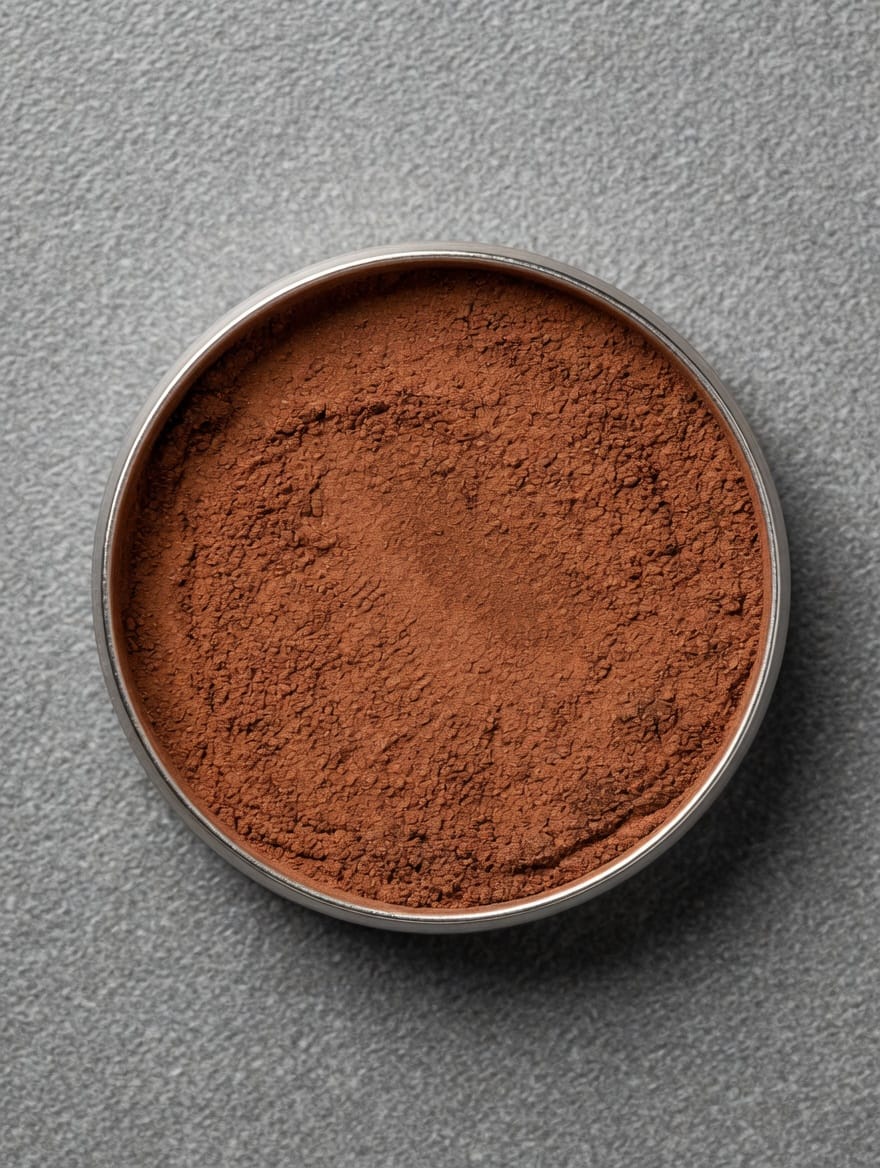
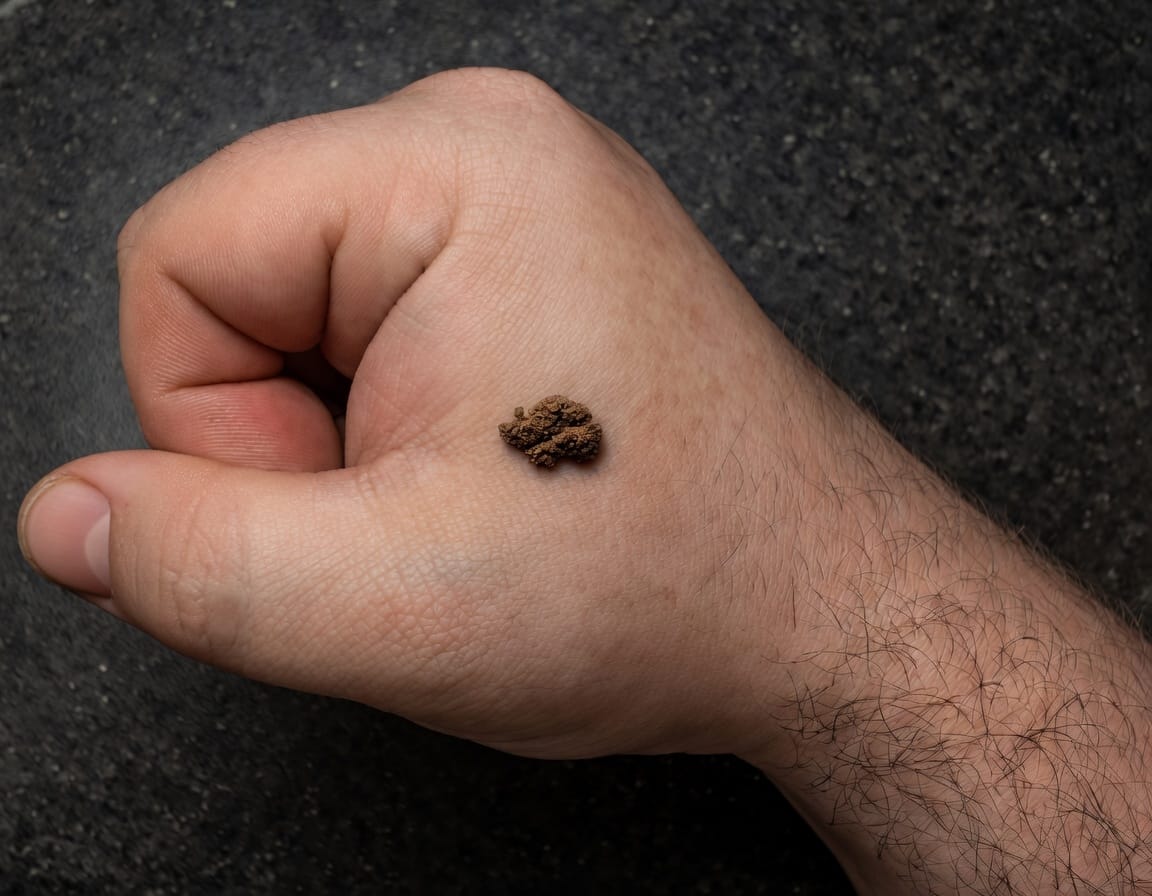
The grind is medium-fine. It sits between the bone-dry, ultra-fine dust of a traditional dry English snuff and the coarser, wetter texture of a Scotch snuff. The moisture content is slightly higher than average for the style, which has a practical benefit: the snuff packs together very slightly when you take a pinch, reducing the likelihood of loose powder escaping before it reaches the nose. It also means the scent is more pronounced and immediate when the tin is opened.
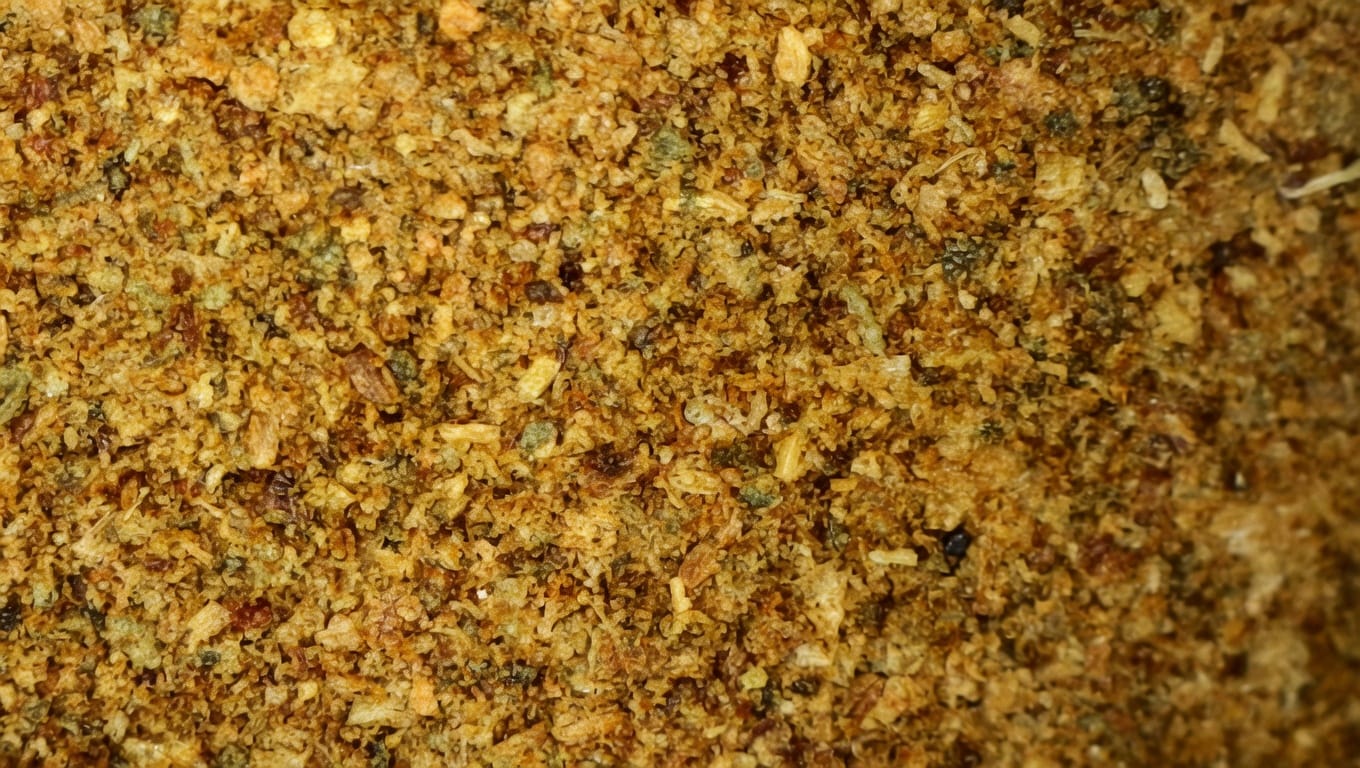
The colour is a warm mid-brown. Under the macro lens it shows visible texture and variation, with occasional hints of green and orange in the mix from the botanical components. It does not look like processed powder. It looks like blended leaf with flavouring applied to something that still has some character of its own.
Flavour Profile
This is where Star Gazer earns its reputation. The dominant note is anise, but it is not the sharp, synthetic anise of an industrial flavouring. It reads as softer and more layered than that, closer to the anise of a quality Pastis or a well-made anise herbal tea than to the single-note sweetness of a boiled sweet. Underneath the anise there is black liquorice, fennel, and what presents as a mild coriander and cardamom warmth. The combination is distinctly Mediterranean in character, at once sweet and slightly spicy, with the herbal notes preventing the sweetness from becoming cloying.
There is no menthol. This is significant. Many flavoured snuffs use menthol either as a secondary note or as a carrier for other flavours. McChrystal's Star Gazer carries nothing of the sort, which means the anise profile is unobscured and the warming quality of the blend comes from the botanicals rather than from any cooling agent in counterplay. The result is a flavour experience that is both more honest and more interesting than menthol-heavy alternatives.
Nicotine strength sits at the low to medium end of the spectrum. It is not a light snuff in the sense of being insubstantial, but it is not going to deliver the kind of head-kick that characterises stronger blends. This makes it genuinely suitable for extended use without building into discomfort, and it makes it a reasonable starting point for anyone new to nasal snuff who wants a flavoured blend rather than a plain or toast-style entry point.
Performance
A small, well-formed pinch works better than a large one. The medium-fine grind responds well to a classic "bullet" or "finger and thumb" technique. Insufflation is smooth, with minimal harshness on the nasal passage. The scent lingers noticeably longer than most snuffs, which is an advantage if you are taking it for pleasure rather than purely for nicotine delivery. The anise note opens up slightly after the first thirty seconds, warming as it settles, and the aftertaste in the back of the throat is mildly sweet without being unpleasant.
How It Compares
The natural comparison point for anyone who has used Hedges L.260 is instructive. L.260 is one of the classic dry English snuffs: fine-ground, low moisture, with a subtle, restrained character that rewards patience and a light hand. It is a benchmark for elegance and approachability in the medium-strength category. Where L.260 is understated and slightly floral, Star Gazer is expressive and aromatic. Where L.260 rewards slow, considered use and repays familiarity over time, Star Gazer gives you its best qualities immediately and consistently.
They are not competing for the same occasion. L.260 suits a quiet moment, a considered pause, something taken with attention. Star Gazer is more sociable, more immediate, and considerably easier to recommend to someone who is not yet familiar with the pleasures of nasal snuff. The aromatic strength means it carries well even in a light breeze outdoors, which is a practical consideration that plain or lightly scented snuffs sometimes fail.
If you use both, as I do, L.260 functions as the everyday carry for situations where subtlety is the priority, and Star Gazer fills the space where you want something with presence. They sit well together in rotation.
Final Assessment
Flavour: Anise-forward, layered, Mediterranean character. Sweet but not cloying. No menthol. Genuinely complex for a flavoured snuff.
Grind/Moisture: Medium-fine, slightly moist, easy to use. Forgiving for beginners and refined enough for experienced users.
Nicotine: Low to medium. Extended use without discomfort.
Presentation: Compact, reliable tin. Honest labelling, appropriate health warnings, no unnecessary redesign.
Value: Strong. Priced accessibly for a quality British product made by a family manufacturer to a recipe approaching a century old.
Verdict: Star Gazer is the most accessible introduction to quality British nasal snuff for anyone who prefers a flavoured profile, and a reliable daily rotation choice for those who already know the category. The enforced name change from Anisette removed nothing from the product. If anything, the neutral name suits it better now: this is a snuff that deserves to be evaluated on what it is, not on what it reminds you of.
Available directly from mcchrystals.co.uk and through a range of specialist retailers.